Extraordinary Super-Eddington Accretion Challenges Theoretical Radiative Equilibrium Limits
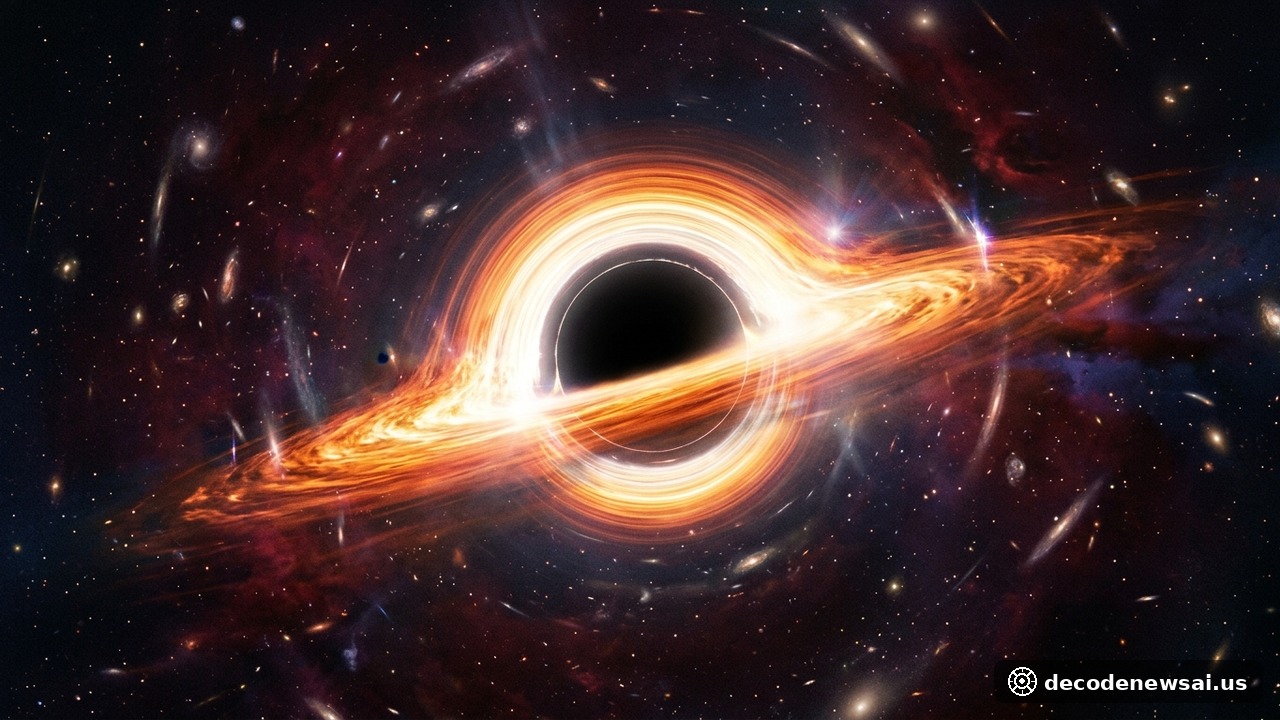
Astrophysicists analyzing observations from the James Webb Space Telescope (JWST) published a discovery on November 13, 2026, in Nature Astronomy, revealing a supermassive black hole candidate in the early cosmic universe. Using the Near-Infrared Spectrograph (NIRSpec), an international research consortium detected a low-mass supermassive black hole designated LID-568 inside a faint host galaxy observed 1.5 billion years after the Big Bang. High-resolution spectroscopic diagnostics confirmed that the black hole is consuming surrounding gas at approximately 40 times its theoretical Eddington limit, documenting the fastest-feeding black hole ever detected in the high-redshift universe.
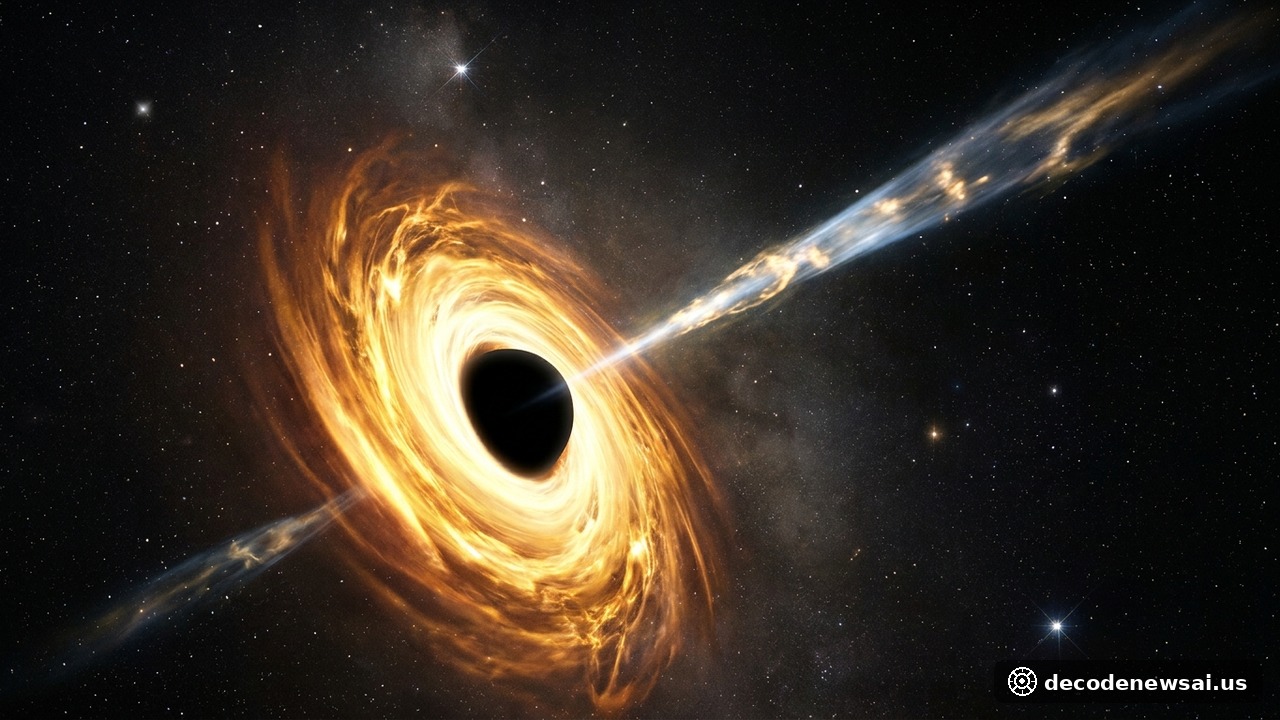
According to technical research releases distributed by the International Gemini Observatory and NSF NOIRLab, the classical Eddington limit defines the physical boundary where inward gravitational forces balance outward radiation pressures generated by superheated infalling matter. Integral field unit spectroscopy aboard JWST revealed that LID-568 generates central ultraviolet and optical luminosities exceeding theoretical mass limits by a factor of 40. Gaseous matter pours directly into the event horizon along collimated accretion channels.
Precision emission-line velocity dispersions revealed that LID-568 possesses a central mass equivalent to approximately 7.2 million times the mass of the Sun. Researchers correlated JWST near-infrared observations with high-energy data from NASA's Chandra X-ray Observatory. X-ray imaging demonstrated that LID-568 lacks heavy obscuring dust columns, while detecting energetic gas outflows and collimated plasma plumes escaping the galactic core at velocities exceeding hundreds of kilometers per second. This outflow mechanism acts as an astrophysical release valve, bleeding excess radiation pressure and permitting continuous cold gas infall into the accretion disk. Senior researchers at the Harvard-Smithsonian Center for Astrophysics noted that empirical verification of super-Eddington feeding provides the missing link explaining how supermassive black holes populated the early universe prior to one billion years after the Big Bang.