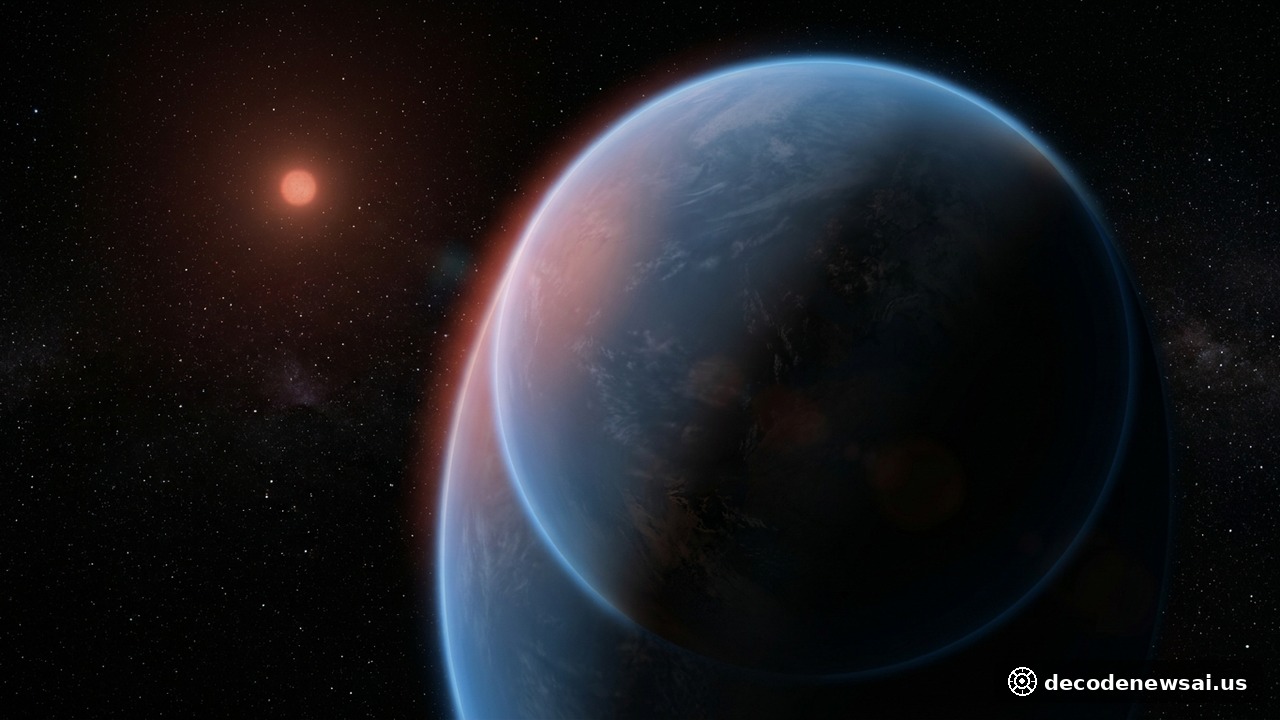
A multinational astronomical research consortium published an exoplanet observation paper in The Astrophysical Journal Letters on November 11, 2026. Utilizing the James Webb Space Telescope Near-Infrared Spectrograph, scientists detected definitive spectral absorption features corresponding to atmospheric water vapor (H2O) and sulfur dioxide (SO2) across habitable-zone super-Earth LHS 1140 b. Positioned 48 light-years from Earth, the planet orbits within the liquid-water habitable zone of its red dwarf star.
Astronomical research teams observed multiple transit occultations of LHS 1140 b across the past twelve months. Near-infrared transmission spectra captured by NIRSpec revealed statistically significant molecular absorption bands at 1.4 and 2.7 microns. Atmospheric models also identified photochemical sulfur dioxide signatures generated by ultraviolet stellar irradiation.
According to reporting from ScienceDaily and NASA Space Science releases, lead investigator Dr. Charles Cadieux of the University of Montreal presented the empirical findings at a research colloquium. Radial velocity mass constraints establish that LHS 1140 b has an average bulk density of 5.9 grams per cubic centimeter. Structural interior models suggest that water constitutes between 10 and 20 percent of total planetary mass, indicating potential global liquid oceans reaching hundreds of kilometers in depth.
Theoretical simulations long postulated that coronal mass ejections from young M-dwarfs strip away primordial and secondary envelopes from close-in rocky worlds. However, LHS 1140 b's robust surface gravity combined with sustained mantle volatile outgassing preserved a nitrogen-dominated secondary atmosphere. Astrophysicists at the Space Telescope Science Institute noted that the co-existence of water vapor and photochemically generated sulfur dioxide hints at ongoing submarine hydrothermal activity. Global astronomy consortia submitted follow-up observing proposals for upcoming JWST operational cycles. Researchers plan to deploy the Mid-Infrared Instrument to perform continuous thermal phase curve mapping. Future spectral sweeps will evaluate the presence of carbon dioxide, methane, and candidate metabolic biosignature gases.