An international astrophysical research consortium published findings on November 13, 2026, in Nature, confirming three ultra-massive galaxies formed within the first billion years following the Big Bang. JWST deep infrared observations identified stellar systems with individual stellar masses comparable to the modern Milky Way. The data reveals early primordial gas reservoirs collapsed into stars with efficiency rates nearly double theoretical expectations under standard cosmological models.
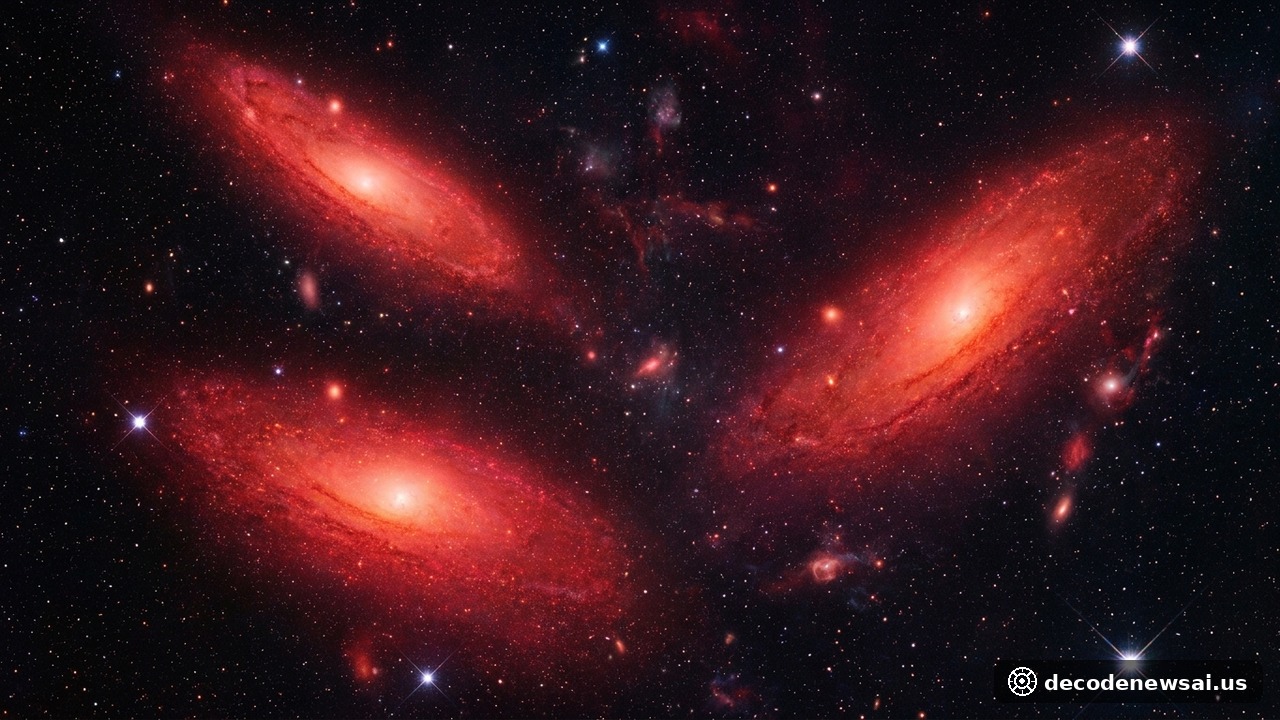
According to peer-reviewed research under the FRESCO high-resolution spectroscopic survey, the three ultra-massive galaxies are designated Red Monsters S1, S2, and S3. Gravitational modeling indicates each system accumulated stellar masses exceeding 100 billion solar masses. Under standard Lambda Cold Dark Matter (Lambda-CDM) cosmological simulations, infant galaxies convert at most 20% of surrounding baryonic gas into stars due to radiative heating and turbulent supernova feedback. However, analytical modeling indicates the Red Monsters demonstrated star-formation efficiencies exceeding lower-mass contemporaries by a factor of two. Lead study author and University of Geneva astrophysicist Dr. Mengyuan Xiao said the results indicate galaxies in the early Universe could form stars with unexpected efficiency, and deeper study would offer new insights into early cosmological epochs. University of Bath Professor of Astrophysics Stijn Wuyts, a senior study co-author, noted prevailing cosmological models typically assume central supermassive black hole radiation and energetic stellar winds constrain rapid star formation; the Red Monsters’ rapid growth suggests early galaxies bypassed established rate-limiting feedback loops.
Previous Hubble Space Telescope deep-sky surveys failed to identify these massive systems because extensive interstellar dust attenuation absorbs ultraviolet light at optical wavelengths. JWST’s Near-Infrared Camera (NIRCam) and Near-Infrared Imager and Slitless Spectrograph (NIRISS) collect longer infrared wavelengths that penetrate dense dust clouds. The instruments captured redshifted hydrogen-alpha emission spectral lines, enabling researchers to determine spectroscopic distances and dynamical masses.