Deep-Space Survey Captures Exquisite Starburst Details
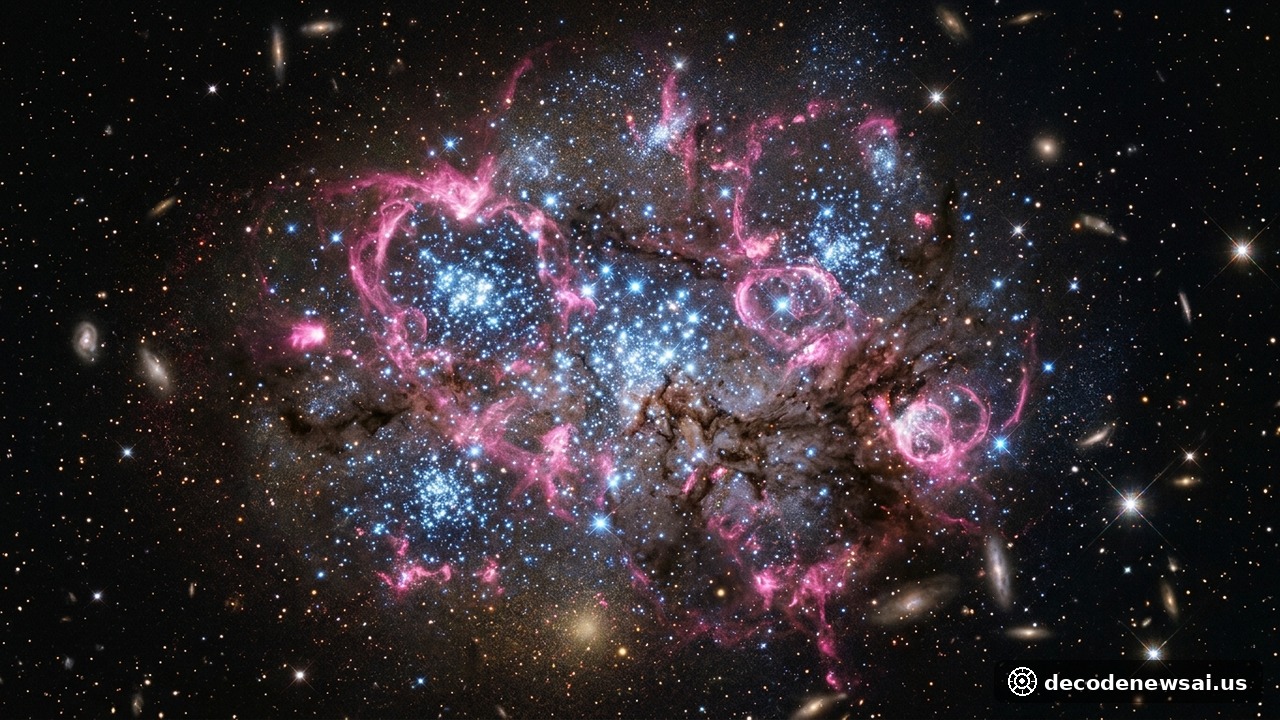
Hubble Telescope Imaging Captures Explosive Starburst Evolution in Irregular Dwarf Galaxy NGC 4449. Astrophysical imagery released by the Hubble Space Telescope science team delivered spectacular insights into cosmic starburst phenomena. Located within the constellation Canes Venatici approximately 12.5 million light-years away, irregular dwarf galaxy NGC 4449 is undergoing a burst of star formation decades ahead of normal galactic evolutionary rates. High-resolution composites reveal thousands of luminous young star clusters embedded in radiant ionized gas. The lead astrophysicist for the ESA Hubble Heritage collaboration explained in the scientific release that NGC 4449 serves as a living cosmic laboratory mimicking high-redshift starbursts, letting researchers dissect how primordial galaxies grew through hierarchical mergers.
Gravitational Mergers Ignite Massive Star Incubators
Astrophysical modeling indicates that this galaxy-wide stellar nursery was ignited by an ancient galactic collision. NGC 4449 gravitationally captured and absorbed a smaller companion dwarf galaxy, unleashing violent tidal forces that compressed diffuse interstellar clouds into stellar nurseries. Newly ignited, high-mass stars generate ferocious stellar winds that carve massive gaseous bubbles throughout the interstellar medium. A senior research astronomer at the Space Telescope Science Institute remarked that synthesizing ultraviolet and infrared observations allowed researchers to map massive stellar wind cavities that drive energetic feedback into the intergalactic medium.
Multi-Wavelength Imaging Overhauls Dwarf Galaxy Evolution
By synthesizing Hubble ultraviolet and optical data with terrestrial neutral hydrogen radio arrays, researchers successfully reconstructed the feedback dynamics governing low-metallicity starbursts. The comprehensive observations provide planetary and stellar astronomers with an accessible analog to understand high-redshift galaxy formation. The findings will substantially refine cosmological simulations of early cosmic structure growth.