Massive Supergiant Wrapped in Unprecedented Egg-Shaped Cocoon
An international team of astronomers led by the European Southern Observatory announced on November 14 the first resolved close-up observation of a star situated in another galaxy. The researchers utilized the Very Large Telescope Interferometer located on Cerro Paranal in Chile's Atacama Desert. The team captured detailed surface and envelope structures of WOH G64, an evolved red supergiant star located roughly 160,000 light-years from Earth within the Large Magellanic Cloud.
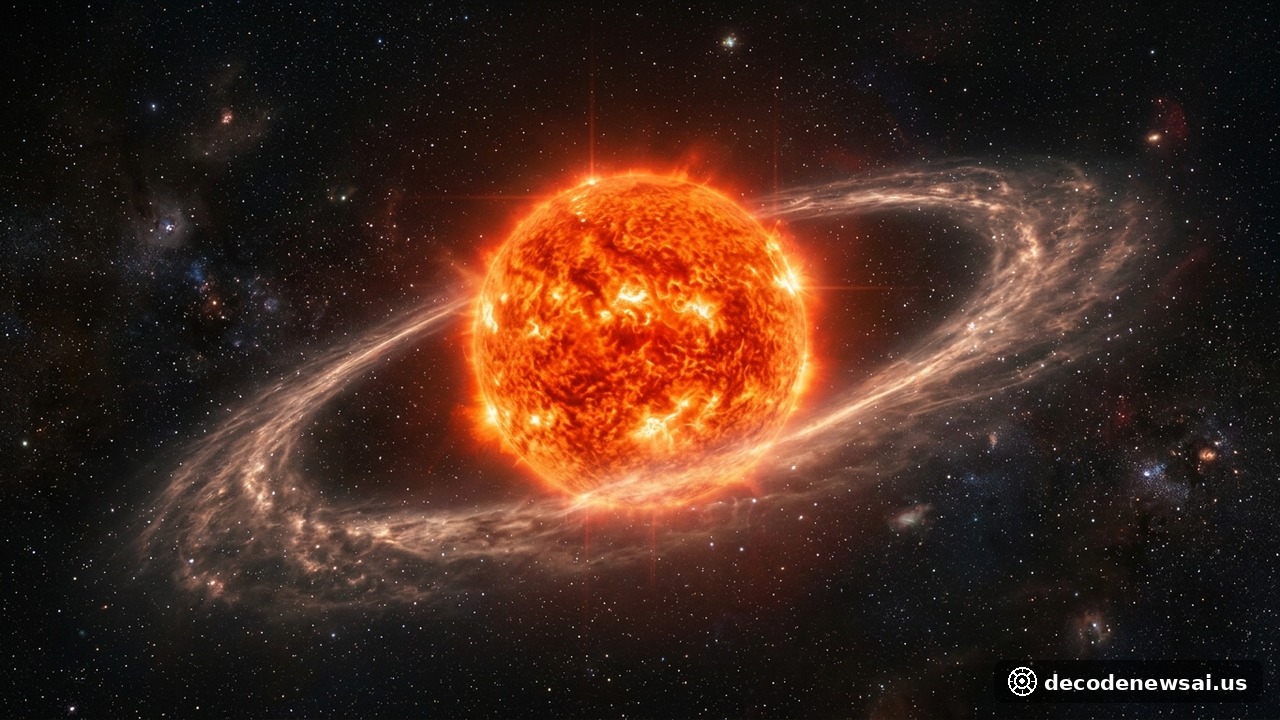
WOH G64 is classified as one of the largest stars known in the local universe, boasting an estimated physical radius approximately 2,000 times that of our Sun; the newly reconstructed high-resolution interferometric images revealed that the supergiant is tightly enshrouded within an unexpected elongated egg-shaped cocoon of warm cosmic dust and gas. Lead author Keiichi Ohnaka, an astrophysicist at Universidad Andrés Bello in Chile, described the findings in a formal European Southern Observatory announcement: "For the first time, we have succeeded in taking a zoomed-in image of a dying star in a galaxy outside our own Milky Way, discovering an unusual egg-shaped dust cocoon closely enshrouding the supergiant."
By cross-referencing the latest observations obtained using the GRAVITY instrument on the VLTI with historical baseline measurements collected over the past two decades, the team discovered that WOH G64 has dimmed considerably. Prior to this observation, astronomers had succeeded in producing resolved close-up images of only about two dozen individual stars, all located within the Milky Way. Resolving stellar features across extragalactic distances of 160,000 light-years previously exceeded the physical diffraction limits of single optical telescopes. The VLTI achieved this spatial resolution by combining the light captured simultaneously by its four 8.2-meter Unit Telescopes, synthesizing an optical baseline equivalent to a single giant telescope tens of meters wide. The scientific findings were officially peer-reviewed and published in the journal Astronomy & Astrophysics.