United States House Speaker Mike Johnson secured the unanimous internal nomination from the House Republican Conference on November 13, 2026, positioning the Louisiana conservative to retain the speakership during the upcoming 119th Congress. The formal party conference vote coincided with official media projections confirming that Republicans secured the 218-seat threshold required to command a statutory working majority in the House of Representatives. Paired with presidential victory and a 53-seat Senate majority, the victory secures unified Republican governance across both legislative chambers and the executive branch. Congressional transition procedures advanced systematically under established statutory timelines. Legislative leadership structures functioned predictably. Conditions remained clear.
Unanimous Voice Vote Clinches Nomination Ahead of Full House Floor Vote on January 3
According to proceedings certified by the House Republican Conference following closed-door party meetings in Washington, Johnson faced no formal opposition, securing the party nomination by unanimous voice acclamation. President-elect Donald J. Trump traveled to Capitol Hill ahead of the leadership elections, delivering personal endorsements of Johnson's legislative stewardship that dissuaded hardline conservative factions from mounting procedural challenges. National election tabulations across late-counting districts in California and Arizona confirmed that Republicans reached the definitive 218-seat legislative majority. The milestone prevents divided congressional governance. Party leadership slates were approved systematically.
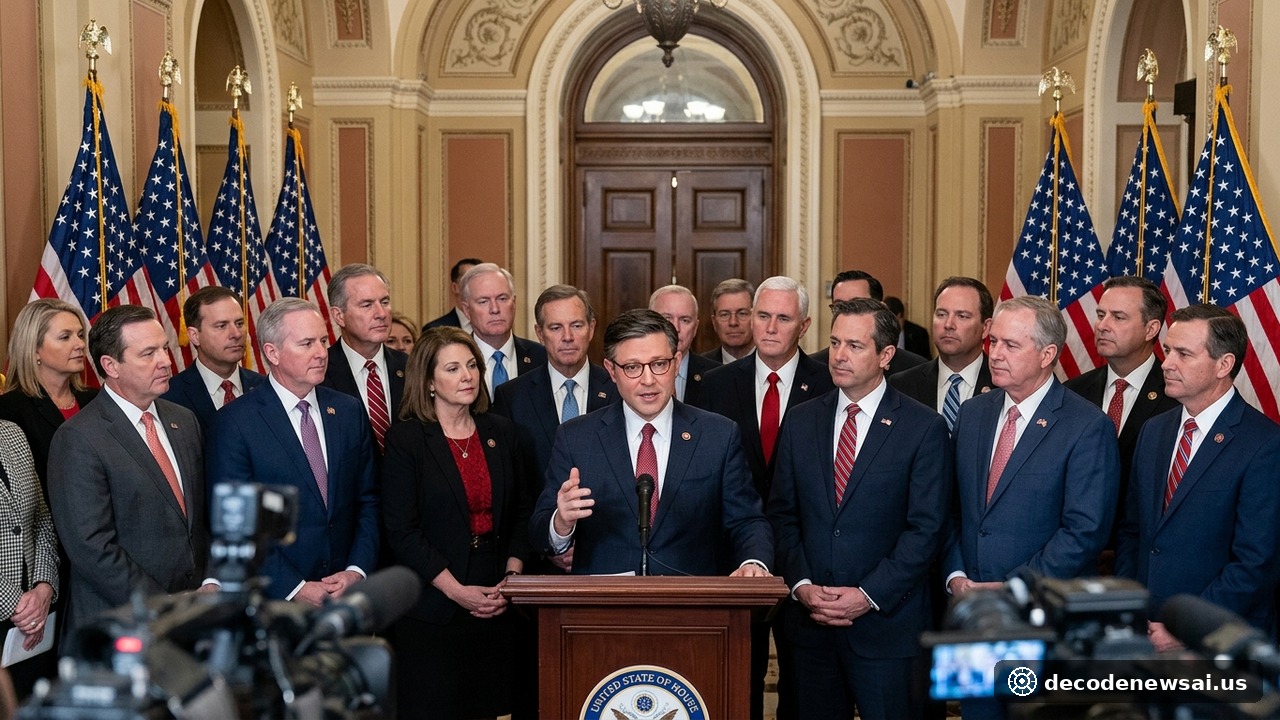
Addressing national media at a Capitol press conference covered by the Associated Press and PBS NewsHour, Johnson framed the Republican legislative triumph as an unequivocal national governing mandate. House Speaker Mike Johnson stated: "We are ready to deliver on America's mandate, and we will hit the ground running with an aggressive agenda that revitalizes our economy and secures our borders." Republican committee chairpersons and rank-and-file lawmakers received the address with unified applause. Congressional legislative planning operated with verified focus.
However, winning the conference nomination represents a preliminary step within federal constitutional procedure. Under Article I of the Constitution, Johnson must assemble an absolute majority of the full House of Representatives—218 votes—during public roll call balloting on January 3, 2025, when the incoming Congress officially convenes. Floor confirmation preparations progressed under careful legal oversight.
Slender House Majority Margin Constrains Procedural Room for Legislative Defections
From a parliamentary governance perspective, the Republican majority is projected to maintain a razor-thin operational advantage of approximately 218 to 222 seats. Consequently, in the absence of floor support from House Democrats, as few as three Republican defections during the public floor vote could deny Johnson the required majority on the initial ballot. Such an outcome would trigger repeat balloting reminiscent of the historic 15-ballot contest that unfolded in January 2023. To prevent procedural gridlock, Johnson initiated bilateral discussions with representatives of the House Freedom Caucus regarding standing chamber operating rules, including protocols governing the motion to vacate the chair. Coalition negotiations remained active across party factions.
Furthermore, several prospective vacancies will briefly compress Johnson's parliamentary working margin during early January sessions. The selection of three senior House Republicans—Representative Matt Gaetz, Representative Mike Waltz, and Representative Elise Stefanik—for executive administration appointments necessitates specialized state special election proceedings to fill open seats. Congressional administrative officers calibrated operational voting schedules.
Capitol Hill procedural analysts noted that balancing requests from fiscal conservatives with the priorities of moderate suburban members represents a central strategic imperative for leadership. Ensuring party discipline remains critical for upcoming legislative sessions. Congressional management teams executed transition duties steadily.
Legislative Agenda Outlines First One Hundred Days Targeting Tax Cuts and Spending Reductions
Addressing forward operational priorities, the House leadership team prepared an extensive legislative roadmap for early 2025. Republicans intend to deploy specialized budget reconciliation mechanisms to enact extensions of the 2017 Tax Cuts and Jobs Act provisions on a simple majority vote. Additional legislative priorities incorporate rescinding unused clean energy appropriations, funding border wall infrastructure installations, and streamlining commercial energy development permitting timelines. Fiscal policy frameworks underwent rigorous economic modeling.
Estimates published by the Congressional Budget Office indicate that permanently extending expiring individual and business tax provisions would add approximately $4.0 trillion to cumulative federal deficits over the coming decade. Reconciling tax reductions with fiscal restraint commitments represents a primary technical focus for the House Committee on Ways and Means. Legislative drafting proceeded according to committee schedules.
Inside the Capitol Rotunda, newly elected members of Congress attended administrative orientation programs and committee assignment briefings. Having consolidated conference backing, Speaker Johnson turned operational focus toward floor preparations for January. The legislative machinery of the United States Congress advanced predictably. Conditions remained clear.