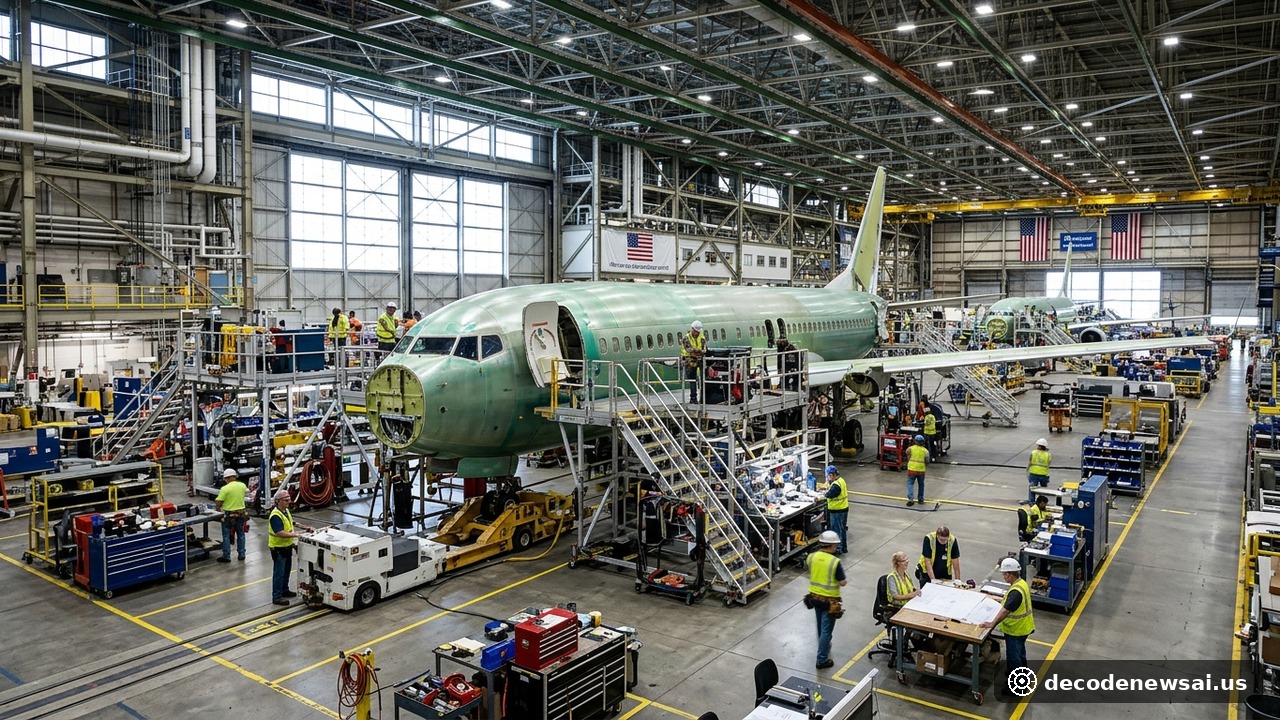
The Federal Reserve Board released statistics on November 15, 2026, confirming United States industrial production decreased 0.3% in October following an unrevised 0.5% decline in September. Total manufacturing output retreated 0.5%, suppressed primarily by a protracted labor strike involving approximately 33,000 aerospace machinists at Boeing commercial jetliner assembly facilities across Washington state. Back-to-back Atlantic hurricanes in late September and October impaired energy extraction and petrochemical processing across the Gulf Coast.
The Federal Reserve’s G.17 release showed the aerospace and miscellaneous transportation equipment index dropped 5.8% in October; Federal Reserve research economists calculated the Boeing work stoppage subtracted an estimated 0.3 percentage point from total manufacturing production growth. Hurricane disruptions added a 0.1 percentage point drag on chemical manufacturing and petroleum refining capacity, while mining output rose 0.3% as oil and natural gas extraction platforms restored offshore operations after storm evacuations. Utilities output declined 0.7% as unseasonably warm autumn weather reduced domestic space heating demand. Total industrial capacity utilization declined 0.3 percentage points to 77.1% in October, 2.6 percentage points below its historical long-term average from 1972 through 2023.
The International Association of Machinists and Aerospace Workers District 751 ratified a four-year collective bargaining agreement in early November, delivering a 38% compounded wage increase and concluding a 53-day strike. The agreement authorized factory technicians to re-enter commercial assembly facilities in Renton and Everett, and manufacturing operations resumed across the 737 MAX and 777 programs. Automotive and parts manufacturing held steady in October, while computer and electronic products output increased 0.4%; food and beverage production eased 0.2%, and textile and paper processing remained flat.
Benchmark Treasury debt yields traded within established ranges, with the 10-year Treasury yield oscillating near 4.45%. Federal energy regulators and freight transportation boards monitored interstate natural gas distribution pipelines ahead of winter heating demands.