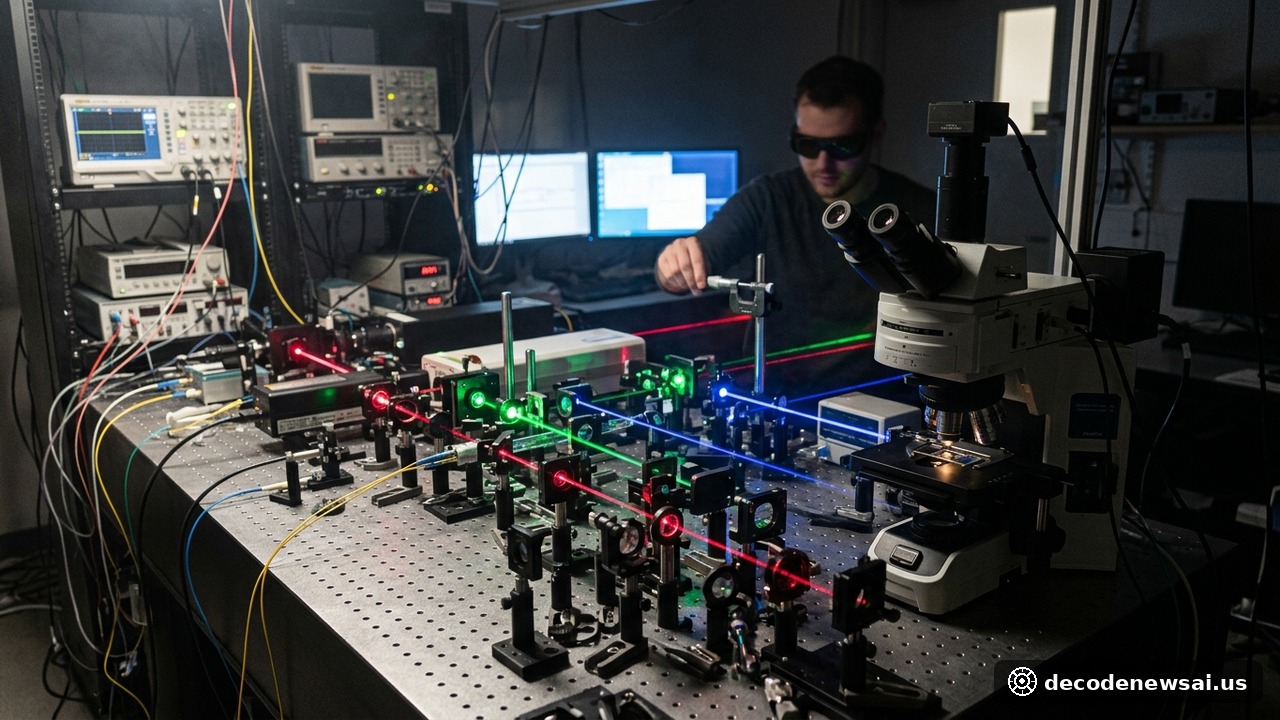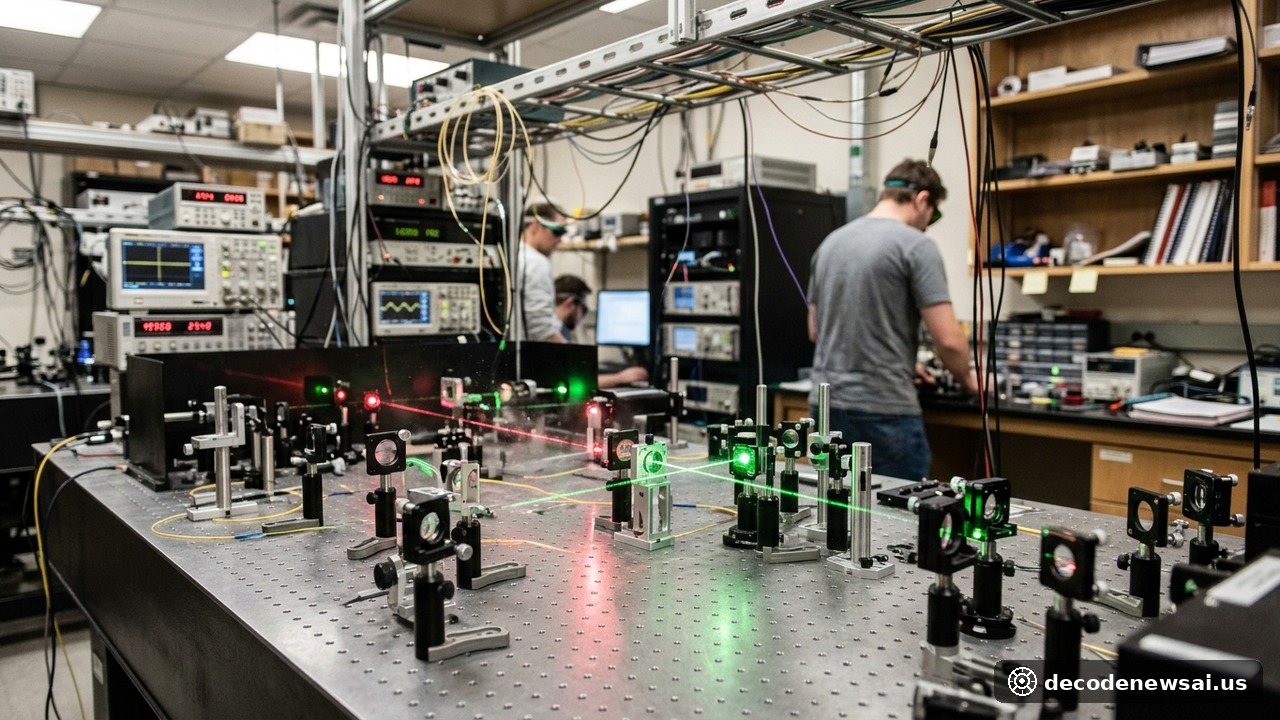
Physicists at the CNRS Institut Pascal in France and international collaborators announced a major scientific breakthrough on Tuesday, successfully creating a quantum supersolid at room temperature. Quantum physics achieves a new milestone. The researchers utilized strongly coupled exciton-polaritons in specialized semiconductor microstructures to achieve macroscopic quantum condensation without cryogenic cooling. The state paradoxically combines crystalline rigidity with frictionless superfluid flow.
Supersolids have fascinated condensed matter theorists for decades due to their dual physical properties. "It looks impossible, but quantum rules do not play by our everyday intuition," researchers noted regarding the unusual physical state. Optical spectroscopy revealed regularly spaced spatial stripes across the polariton density, confirming spontaneous continuous symmetry breaking. The system independently selected equivalent spatial phases after successive optical laser excitations.
Simultaneously, polarimetric detection captured a persistent spin helix, indicating ordered spatial precession of light polarization. "The observed density stripes and spin helix match theoretical predictions for supersolid polariton condensates," confirmed Professor Guillaume Malpuech. The hybrid quasi-particles exhibited robust quantum collective coherence across microscopic dimensions. Dual manifestations of translational and spin order established rigorous empirical proof.
Crucially, the experimental platform demonstrated direct electrical tunability, enabling optical properties to be modulated via external gate voltages. Operating at ambient room temperature eliminates bulky cryogenic refrigeration, bringing exotic quantum phenomena into practical solid-state architectures. The methodology provides a versatile engineering foundation for next-generation photonic computing and ultra-sensitive optical sensing. The breakthrough opens compelling horizons for room-temperature topological quantum devices.