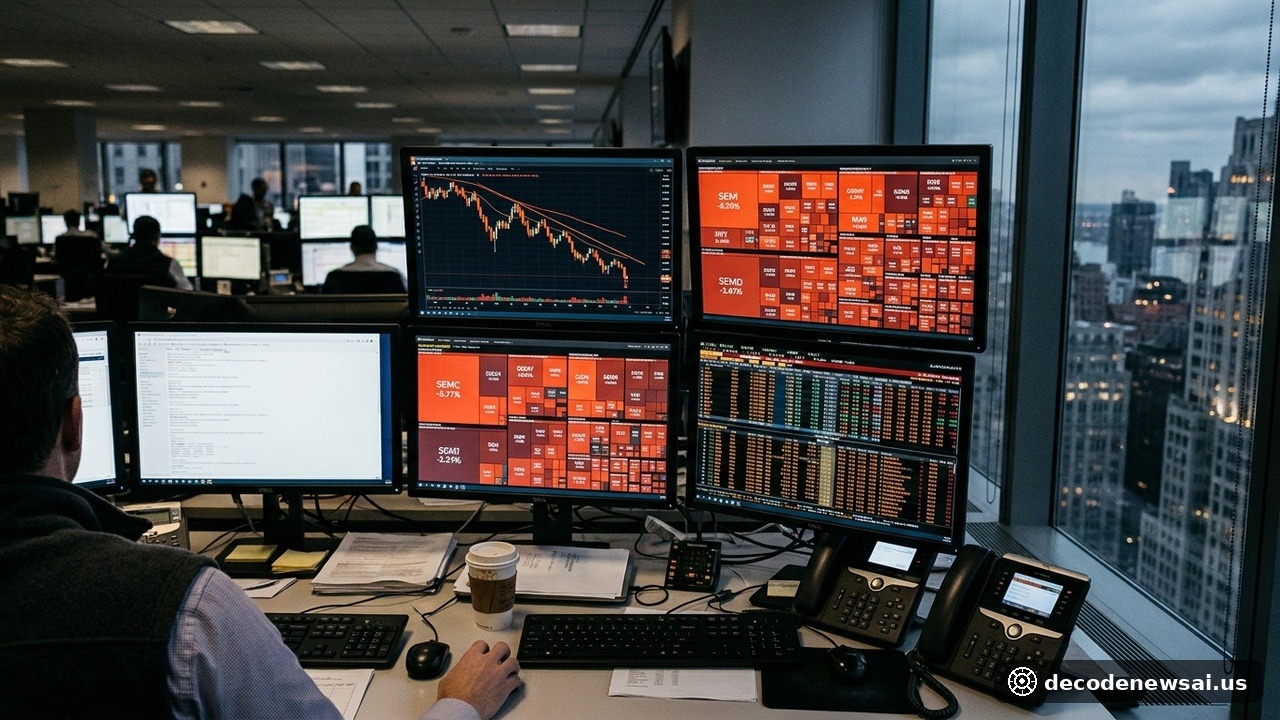
On November 5, 2026, leading financial media organizations including Seeking Alpha and Business Insider reported that famed hedge fund manager Michael Burry—famed for his prescient subprime mortgage bets chronicled in "The Big Short"—disclosed that he sold 25 percent of his put options on the $59 billion VanEck Semiconductor ETF to take partial profits amid a broad-based rout in American technology equities. The disclosure was shared via his personal Substack publication, "Cassandra Unchained," within his latest market dispatch titled "Trading Post November 5, 2026." Despite monetizing a portion of his lucrative options trade, Burry emphasized that he remains overwhelmingly bearish on the broader artificial intelligence complex, asserting that equity valuations remain dangerously disconnected from underlying corporate fundamentals across the hardware ecosystem.
Monetizing Derivative Gains While Maintaining Heavy Downside Exposure
Writing in his market update, Burry clarified that despite trimming 25 percent of the derivative position, his remaining SMH put holdings have grown substantially in portfolio weight due to recent market declines, characterizing them as having "become very large positions." This transaction builds upon a broader strategic portfolio consolidation executed in October 2026, when Burry concentrated the majority of his bearish exposure into long-dated put options expiring in 2027 across both the VanEck Semiconductor ETF and the Invesco QQQ Trust ETF tracking the tech-heavy Nasdaq-100 index. At the time of that repositioning, Burry explicitly cautioned that he anticipates a historic macro market peak developing within nine months. Beyond broad technology benchmarks, Burry confirmed that he continues to maintain active put positions against prominent enterprise bellwethers, including software titan Oracle (ORCL), data analytics firm Palantir (PLTR), and industrial machinery manufacturer Caterpillar (CAT).
By harvesting liquidity during acute selloff days, the hedge fund manager preserves flexibility while ensuring that his core bearish stance remains fully intact across long-duration derivative maturities extending into 2027.
Warning That Anthropic Bets Its Existence on Optimism Amid $895.4 Billion Commitments
Beyond his derivative maneuvers in the public semiconductor sphere, Business Insider reported that Burry delivered a scathing critique regarding the financial trajectory of artificial intelligence laboratory Anthropic, which is currently preparing for an initial public offering. Scrutinizing Anthropic's amended Form S-1 registration statement filed with the Securities and Exchange Commission on November 2, Burry bluntly observed: "Not only is the company priced for optimism, it is betting its entire existence on that optimism." He explicitly stated that he has no intention of acquiring or owning shares of the company upon its public debut.
While Anthropic's amended prospectus revealed that third-quarter revenue expanded dramatically to $17 billion, the financial disclosures also laid bare escalating compute expenditures that threaten to outpace top-line monetization over multi-year horizons. Burry directed sharp analytical scrutiny toward a staggering figure buried within the filing: Anthropic has formally entered into binding contractual agreements committing $895.4 billion toward artificial intelligence compute power, advanced silicon processors, and specialized data center infrastructure necessary to train and execute its next-generation frontier models. In Burry's assessment, such unprecedented capital expenditure requirements expose the venture to existential liquidity and operational vulnerabilities should commercial AI monetization encounter cyclical deceleration or customer attrition.
Strategic Long Accumulation in MercadoLibre Amid Market Volatility
In contrast to his aggressive short positioning across artificial intelligence infrastructure, Burry demonstrated selective value-driven bullishness by expanding exposure to Latin American e-commerce and fintech enterprise MercadoLibre (MELI). Following the release of the company's third-quarter earnings report, Burry took advantage of post-earnings price weakness to accumulate additional equity shares below the $1,500 threshold.