A Single Marsquake Shows the Solar System's Largest Canyon Is Still Moving
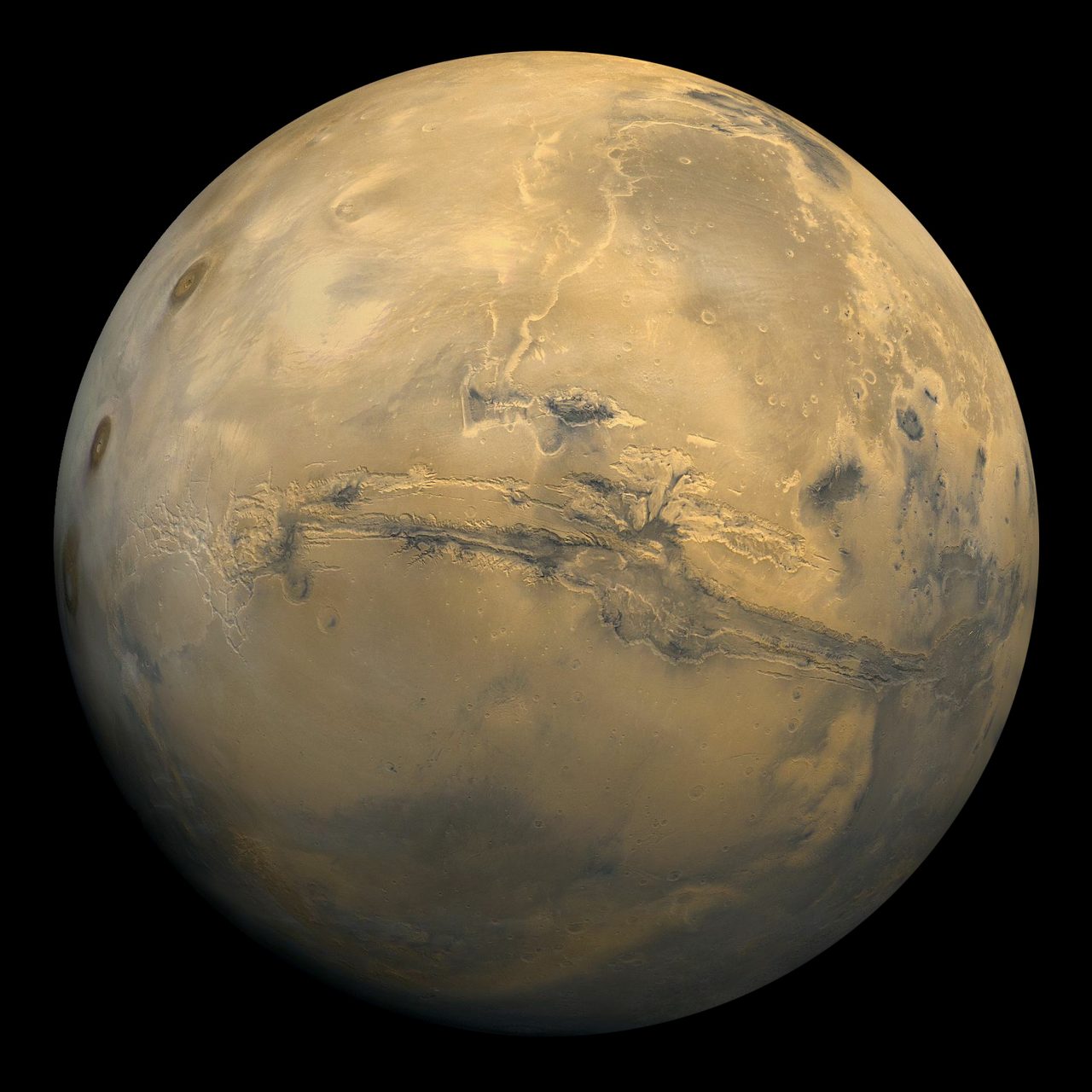
Photo: NASA / public domain · via Wikimedia Commons
A Single Marsquake Shows the Solar System's Largest Canyon Is Still Moving
A 3,900-kilometre canyon system dwarfs Earth's Grand Canyon
Valles Marineris is the largest canyon system in the solar system, stretching nearly 3,900 kilometres across Mars, reaching up to 600 kilometres wide and more than 9 kilometres deep. That makes it nearly nine times longer, more than 20 times wider and about five times deeper than the Grand Canyon at their respective maximum dimensions. New research finds that this vast structure, formed billions of years ago, is still tectonically active and shaping Mars today.
Quake S0976a came from the opposite side of the planet
The study centres on a seismic event called S0976a, recorded by NASA's InSight lander on 25 August 2021, on Sol 976 of the mission. It was unusual because it came from the opposite side of Mars from the lander and was the only marsquake detected during the mission that could be located in the planet's western hemisphere. The paper places it at an epicentral distance of about 146 degrees plus or minus 7 degrees, with a back azimuth of 101 degrees plus or minus 25 degrees, in western Valles Marineris near Ius Chasma.
Rupture at 20 to 40 kilometres depth moved sideways
The best explanation is a strike-slip marsquake, in which blocks of crust move horizontally past one another along a steep, deeply rooted fault. The rupture occurred roughly 20 to 40 kilometres beneath the surface of western Valles Marineris, or about 12 to 25 miles deep. Seismic waves indicate sideways sliding well below the surface, while geology seen from orbit shows a region crossed by long-lived fault systems. The authors say several completely different lines of evidence point in the same direction.
Columbia and Imperial team ties quake to reactivated faults
The work was carried out by scientists at Columbia University and Imperial College London, led by Jung-Hun Song and colleagues, with senior author Doyeon Kim, assistant professor in Earth and Planetary Science at Imperial. It was published in Nature Communications as Active crustal straining and fault reactivation at Valles Marineris. Kim said S0976a had proved extraordinary because its waves travelled through the core and helped investigate the deepest part of Mars, and now reveal an active fault beneath one of its most remarkable landscapes.
Cooling, Tharsis loading and erosion keep stressing the crust
The inferred stress orientation is consistent with reactivation of pre-existing fault systems under a present-day stress field shaped primarily by long-term planetary cooling, regional Tharsis-related loading, and surface erosion-related local unloading. In other words, faults established during the formation and early evolution of Valles Marineris billions of years ago can remain weak enough to rupture under current stresses. The finding suggests ancient tectonic fabric can localise present-day seismic failure.
Stagnant-lid planets can still deform and quake today
The result changes the picture of Mars from a largely dead world to one with contrasting styles of present-day deformation: strike-slip faulting beneath Valles Marineris from S0976a, compressional faulting near the crustal dichotomy in southern Elysium Planitia inferred from event S1222a, and normal faulting beneath Cerberus Fossae. For future exploration, seismic hazard, landslides and slope instability around Valles Marineris matter for landing-site choice and traverse planning, and the canyon becomes a priority target for any future seismic network.
More quakes needed to map how much of the canyon moves
One western-hemisphere quake cannot by itself show how much of the system is active. The next step is to test the inference with more events, denser orbital mapping of reactivated faults, landslides and syn-tectonic deposits, and comparison with the other two tectonic provinces sampled by InSight. If the inherited faults are as weak as this event implies, similar ruptures should recur, and continued monitoring can establish the rate and distribution of present-day activity.
Sources
- Columbia Climate School
- Lamont-Doherty Earth Observatory
- Phys.org
- Nature Communications
- Imperial College London