The Liberty Bell Has Been Silent for 180 Years. Physicists Just Rebuilt Its Sound.
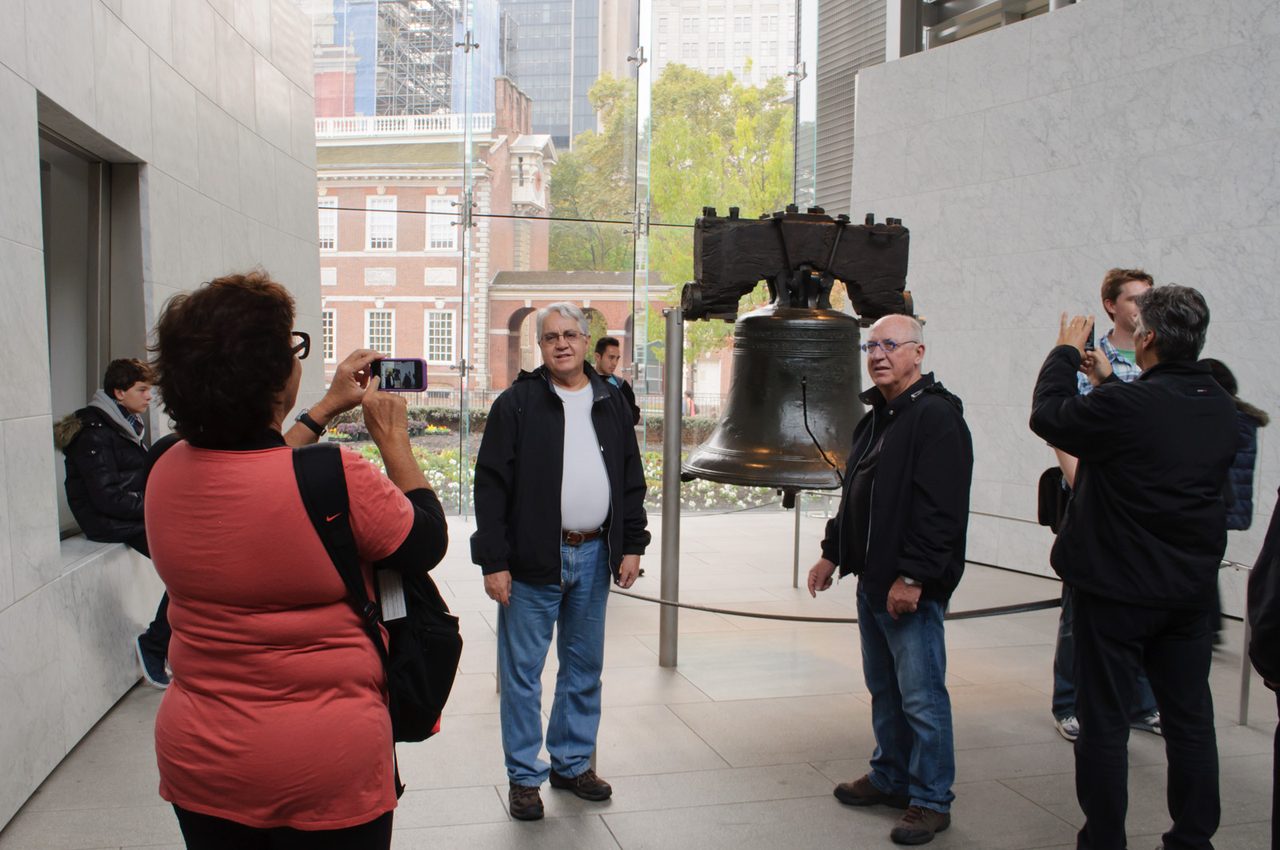
Photo: InSapphoWeTrust from Los Angeles, California, USA / CC BY-SA 2.0 · via Wikimedia Commons
The Liberty Bell Has Been Silent for 180 Years. Physicists Just Rebuilt Its Sound.
A replica stands in for a mute icon
America's most famous bell has not made a sound since 1846, so researchers in Pennsylvania asked a stand-in to do the talking. A team from Penn State turned to a full-size replica on the Penn State Behrend campus, struck it, recorded how it vibrated, and then used modal analysis — a technique acousticians have relied on for decades — to model what the original would have sounded like. The work was presented at an Acoustical Society of America meeting in Philadelphia and written up by Physics Today on October 5, timed to the 250th anniversary of US independence. Sean Collier, a co-author, told Ars Technica that building a sound from the thin information available online produces "a terrible sounding bell that in presence does not match the silhouette of the iconic bell."
Three questions the study set out to answer
The authors wanted to know which notes a listener hears when the bell rings, how the bell deforms as it vibrates, and which notes ring the longest. A bell's sound is set by two things: geometry, which determines the vibration patterns that radiate toward a listener, and material — bronze — which fixes the exact pitch and how long the ring lasts.
Five frequencies, measured off the copy
On the Behrend replica the team measured a hum note at 174 Hz, a fundamental at 323 Hz, a tierce at 381 Hz, a quint at 510 Hz and a nominal at 623 Hz.
The fundamental sits between E-flat and E
At 323 Hz, that fundamental falls between E-flat and E above middle C. Normalizing the first five frequencies against the fundamental gives ratios of 0.54, 1.00, 1.18, 1.58 and 1.93 — very close to the tuning of an ideally tuned bell, which means the original was better in tune than its cracked reputation suggests.
Why a big bell sounds mournful
Western church bells are normally tuned to those first five frequencies, following well-defined ideal ratios. "Musically, the frequencies sound as a minor triad, which is why church bells are commonly perceived as having a somber tone," the authors wrote. What listeners actually hear as the pitch is a subjective "strike note", produced by the way the mode shapes interact and by the listener's own expectations.
The official record: silent since February 1846
According to the National Park Service, the bell last rang on February 23, 1846, for George Washington's birthday, and it has been silent ever since. The bell is displayed at the Liberty Bell Center in Philadelphia's Independence National Historical Park, which is free to enter and draws millions of visitors a year. No living person has heard it ring.
The famous gap is a repair, not the crack
The Park Service's likeliest account is that a narrow split opened in the early 1840s, after nearly 90 years of use, and that an earlier crack was noted sometime after 1817. Before Washington's birthday in 1846, metalworkers widened the crack with a technique called stop drilling, hoping to halt its spread and restore the tone. The repair failed: a second crack ran from the abbreviation "Philada" up through the word "LIBERTY", and the bell has been mute since. The wide gap visitors see today is the repair, not the original break; more than forty drill marks are visible in it.
The alloy was poor to begin with
The bell weighed 2,080 pounds when ordered and is roughly 70% copper and 25% tin, with small amounts of lead, gold, arsenic, silver and zinc. It was cast in London in 1752 by the Whitechapel foundry, then known as Lester and Pack, and cracked on its first test ring in Philadelphia; local metalworkers John Pass and John Stow recast it twice in 1753. Winterthur Museum's metallurgical analysis found the alloy unusually lead-heavy, leaving the metal brittle and its sound dull. Anne Paccard of the Paccard foundry, which cast the 1950 replicas, told the Associated Press: "I must say that the original Liberty Bell is a very poor quality bell, metallurgically speaking." Those replicas used "airain", 78% copper and 22% tin, nothing else.
A sound no living ear can check
Because nobody alive has heard the bell, the study is less nostalgia than archaeology: it turns a piece of sensory history into something quantitative that curators can use for exhibits and that commemorations can play without guesswork.
Replicas do the ringing now
For a savings bond drive in 1950, the Treasury Department commissioned copies of the famously broken bell, one for each state and several territories — faithful down to the Pass and Stow mark and a faux crack. This year Idaho's copy, freshly restored, is touring all 44 counties for the first time in more than 70 years, and visitors line up to ring it themselves. The Bells Across America events marking the signing of the Constitution follow the same instinct.
A new bell and a digital twin carry it forward
For the 250th anniversary, the National Bell Festival is coordinating the casting of a new public bell honoring 250 years of women's contributions to US history, which will lead nationwide ringing tributes. Meanwhile, Penn State Behrend researchers are also 3D-scanning the bell to build virtual experiences. The original stays silent; its voice now lives on as a model, a set of replicas, and a new bell.
Sources
- Ars Technica: What did the Liberty Bell sound like? Science is on the case.
- Physics Today: What did the Liberty Bell sound like?
- Liberty Bell in Philadelphia: how a cracked bell became America's icon
- Meet the Liberty Bell fans visiting little-known replicas scattered across the country
- PPLPod: The Liberty Bell's Real History: Cracks, Myths and Abolitionists